
Utah Gov. Spencer Cox and First Lady Abby Cox: The Hard Work of Staying Together
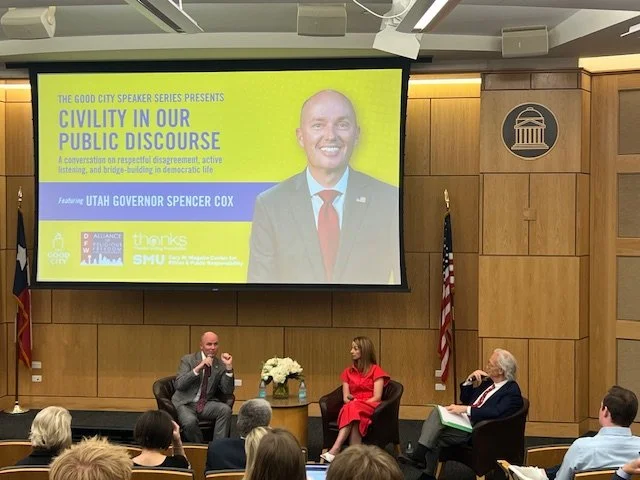
On a spring evening at SMU, the room filled not with partisans, but with neighbors—people willing, at least for a night, to sit in the same space and consider a harder question: how do we stay in relationship with one another when we don’t agree? That was the ambition behind The Good City™ Distinguished Voices Speaker Series on March 30, where Utah Governor Spencer Cox and First Lady Abby Palmer Cox joined a Dallas audience to model something rare—what it looks like to listen, to engage, and to disagree without losing sight of our shared humanity.
Hosted by Thanks-Giving Square in partnership with the SMU Cary M. Maguire Center for Ethics and the DFW Alliance for Religious Freedom, the evening unfolded less like a political event and more like a civic exercise—one rooted in the belief that democracy depends not only on what we believe, but on how we treat one another.
Governor Cox, widely known for his “Disagree Better” initiative, began not with policy, but with perspective. Standing on the threshold of America’s 250th year, he invited the audience to reconsider the foundations of the country itself. The Declaration of Independence, he noted, offers not just rights, but a framework for responsibility.
“We believe that all of us are created equal,” he said, before turning to a phrase that has drifted in meaning over time: the pursuit of happiness. Today, he observed, that phrase is often interpreted as personal fulfillment or pleasure. But to the founders, it meant something more demanding—the pursuit of personal excellence, of virtue, of becoming the kind of person capable of sustaining a free society.
“It was about making yourself better every day,” he said, “and lifting others in the process.”
The distinction matters. Freedom, he suggested, is only half the equation. The other half is responsibility—and in that, modern culture has grown less certain.
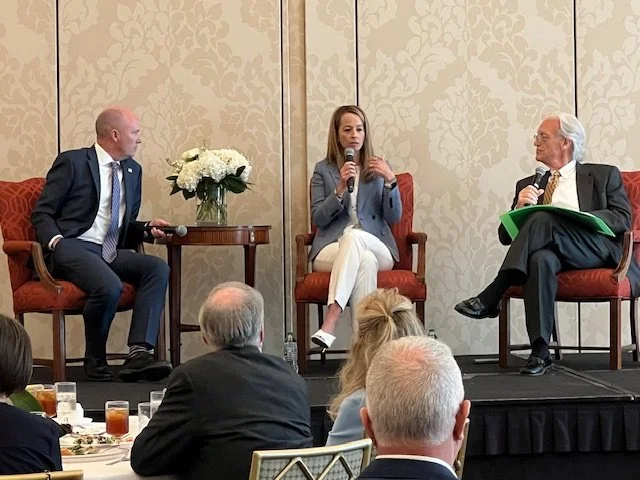
That thread carried into the evening’s broader conversation with Kyle Ogden, President and CEO of Thanks-Giving Square, who guided the dialogue with a steady hand. The discussion moved from philosophy to practice, from founding ideals to present realities. Gov. and Mrs. Cox were also the guests of Thanks-Giving Square’s The Good City Salon at a luncheon on Tuesday at Arts District Mansion where Kyle also hosted a similar Q&A with the couple.
One of our current realities is the steady erosion of community.
Cox pointed to a shift decades in the making—away from shared spaces and toward isolated ones. What began with television has accelerated with smartphones and social media, creating a culture where connection is simulated but rarely sustained.
“If we don’t have any real friends,” he said, “we can hate the same people together on Facebook.”
The line drew a knowing response, but the underlying point was serious. The incentives of modern media reward outrage, not understanding. They pull attention away from the people and places closest to us, and toward a constant stream of conflict that rarely asks anything of us except reaction.
For First Lady Abby Cox, that reality is especially visible in the lives of young people. Drawing on her background in education, she spoke about the impact of technology in schools—where attention has become a contested resource, and teachers are often at a disadvantage.
“Their brains are being completely hacked,” she said of students navigating a flood of notifications and digital distractions.
Efforts in Utah to remove phones from classrooms have shown promising results: fewer disruptions, more engagement, and a measurable increase in learning. But for her, the issue extends beyond devices. It raises a deeper question about formation—about what kind of people schools and communities are shaping.
“We have to be partners,” she said, referring to the shared responsibility of parents, educators, and communities. “We can’t just hand that off.”
That idea—shared responsibility—surfaced again when the conversation turned to civility. It is a word often used, Cox noted, but rarely understood.
Civility, in his view, is not about being agreeable or avoiding conflict. It is about engaging more fully, not less—about holding convictions while remaining open to others. “Disagree better isn’t about less debate,” he said. “It’s about more debate… done the right way.”
He offered a story from his own campaign as an example. In 2020, amid a tense national climate, Cox partnered with his Democratic opponent to create a joint advertisement. The message was straightforward: they disagreed on policy, but they shared a commitment to their state and to each other as fellow citizens.
The ad reached millions, not because it was novel, but because it felt familiar—a reminder of a time when disagreement did not require disdain.
“We can do that again,” he said.
The idea has since grown into a national effort, supported by research suggesting that such examples can reduce political hostility. But throughout the evening, the emphasis remained less on programs and more on habits—on the small, daily choices that shape how people show up in the world.
For Abby Cox, that principle is captured in a simple phrase: show up.
“You can pretend to care,” she said, “but you can’t pretend to show up.”
Her work across Utah—with foster children, individuals with disabilities, and educators—is built around that idea. Service, she explained, is not only about helping others. It is also a way of restoring connection, of grounding people in something larger than themselves.
“It’s hard to hate up close,” she added.
As the evening drew to a close, the conversation turned toward what comes next—what it means to carry these ideas beyond a single gathering.
Abby Cox encouraged the audience to seek out people whose experiences differ from their own, and to approach those encounters with curiosity rather than certainty.
Governor Cox offered a final reflection, drawing a distinction between optimism and hope.
“Optimism is the idea that good things are just going to happen,” he said. “Hope is the idea that good things are going to happen because we can make them happen.”
It was a fitting close to a conversation rooted not in abstraction, but in agency. The work of rebuilding trust, of restoring community, of learning to disagree without dividing—it does not begin at the national level. It begins closer.
“One neighbor, one community at a time,” he said.
And in that room, for a brief and intentional hour, that work was already underway.