
The Good City Salon: What Does It Mean to Be Human in the AI Age?

At Arlington Hall at Dallas’ Turtle Creek Park, the Thanks-Giving Square Good City Salon on Feb. 23 centered on a question that feels increasingly urgent: What does it mean to be human in the age of artificial intelligence?
Kyle Ogden, President and CEO of Thanks-Giving Foundation, introduced the keynote speaker, Dr. Robert Hunt, as both a friend and a scholar who has dedicated his career to exploring what it means to remain deeply human in a rapidly changing world . Dr. Hunt serves as Director of Global Theological Education and Professor of Christian Mission and Interreligious Relations at Southern Methodist University. He holds degrees from The University of Texas at Austin, Southern Methodist University, and a PhD in History from the University of Malaya .
At the heart of his work is a strong conviction: the humanities—history, philosophy, religion, literature—are not optional extras. They form the foundation for leadership in business, politics, science, and public life . In an era when AI can process information faster than any human, Dr. Hunt argues that machines still cannot model the most essential lesson: how to be a human among other humans .
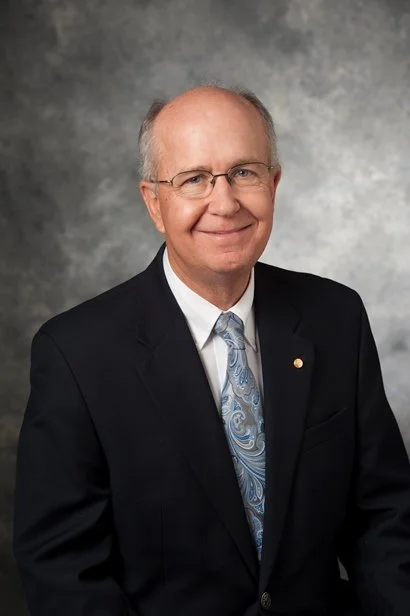
Dr. Hunt began with a personal story. As a high school senior, he was introduced to early forms of machine intelligence while programming complex equations in Fortran to interpret satellite data . Though his project ended in failure, the experience connected him to the rise of personal computing. He later helped build computer networks linking schools in Malaysia and Singapore in the 1980s and 1990s .
Years later, at a university conference on the “Second Machine Age,” a keynote speaker made a striking claim: in the coming AI era, the liberal arts and humanities would become the most important disciplines, because human values would determine how technology is used . That insight eventually led Dr. Hunt to write his new book, All Brain and No Soul – Real Humanity in an AI Age.
He summarized his central argument in one powerful statement:
“The growing presence of humanly created artificial intelligence is reshaping the foundations upon which the human search for self-understanding must build” .
In other words, AI isn’t just another tool. It forces us to rethink how we understand ourselves. In this new age, we might start to see ourselves as machines—or even as godlike creators. But the deeper challenge is to understand ourselves as fully human .
Dr. Hunt described two major historical shifts.
The first is how modern science led us to think of the human body as a machine. This perspective brought enormous medical advances—artificial heart valves, cataract replacements, joint implants. But it also shaped a powerful metaphor: if our bodies are machines, perhaps our brains are computers.
The second shift is the development of artificial intelligence. Early researchers believed that if the brain functions like hardware, then intelligence could be recreated in silicon. Advances in neural networks and back propagation made AI systems increasingly capable. But scientists also realized something important: AI does not function like a human brain. It operates differently—an “alien intelligence” .
Large language models such as ChatGPT do not actually understand meaning. They break language into tokens—small fragments—and calculate the most probable next token in a sequence . When ChatGPT 3.5 launched in November 2022, it reached one million users in just five days—the fastest technological adoption in history . Today, AI is embedded in search engines, legal systems, grammar tools, financial platforms, and countless digital services .
Yet Dr. Hunt emphasized: AI does not think. It calculates probabilities .
So if reasoning and calculation can be replicated by machines, what distinguishes us?
During the Q&A, Dr. Hunt revisited Aristotle’s belief that rational thought separates humans from other species. Medieval Christian theology built on this, arguing that humans share in the mind of God . But if reasoning can be simulated, perhaps that is not the whole story.
Dr. Hunt suggested that love—something not reducible to logic or calculation—is central to human identity . He also emphasized embodiment. Human intelligence is not confined to the brain; it is lived through the body, shaped by sensation and perception . We are not disembodied processors. We are embodied beings.
Equally important is relationship. Humans do not exist in isolation. We are formed within families, communities, and societies . Current AI systems are not shaped by lived relationships. That difference matters when we talk about personhood.
Finally, Dr. Hunt offered a moral warning. If we regularly interact with machines that appear human but treat them as objects, we may develop habits that weaken how we treat real people . The danger is not a robot uprising. The danger is a slow erosion of human character.
He concluded with a simple but challenging reminder:
“We will find what it means to be human when we put down our screens and we turn off our robots… and turn to our fellow humans” .
The first Good City Salon did not call for rejecting AI. Instead, it called for clarity. As artificial intelligence becomes more powerful and widespread, the real question is not whether machines can think. It is whether we will continue to value love, embodiment, relationship, dignity, and community.
In the AI age, understanding technology matters. But understanding ourselves matters even more.