
For 50 Years, A Spiral of Light: The Chapel of Thanks-Giving
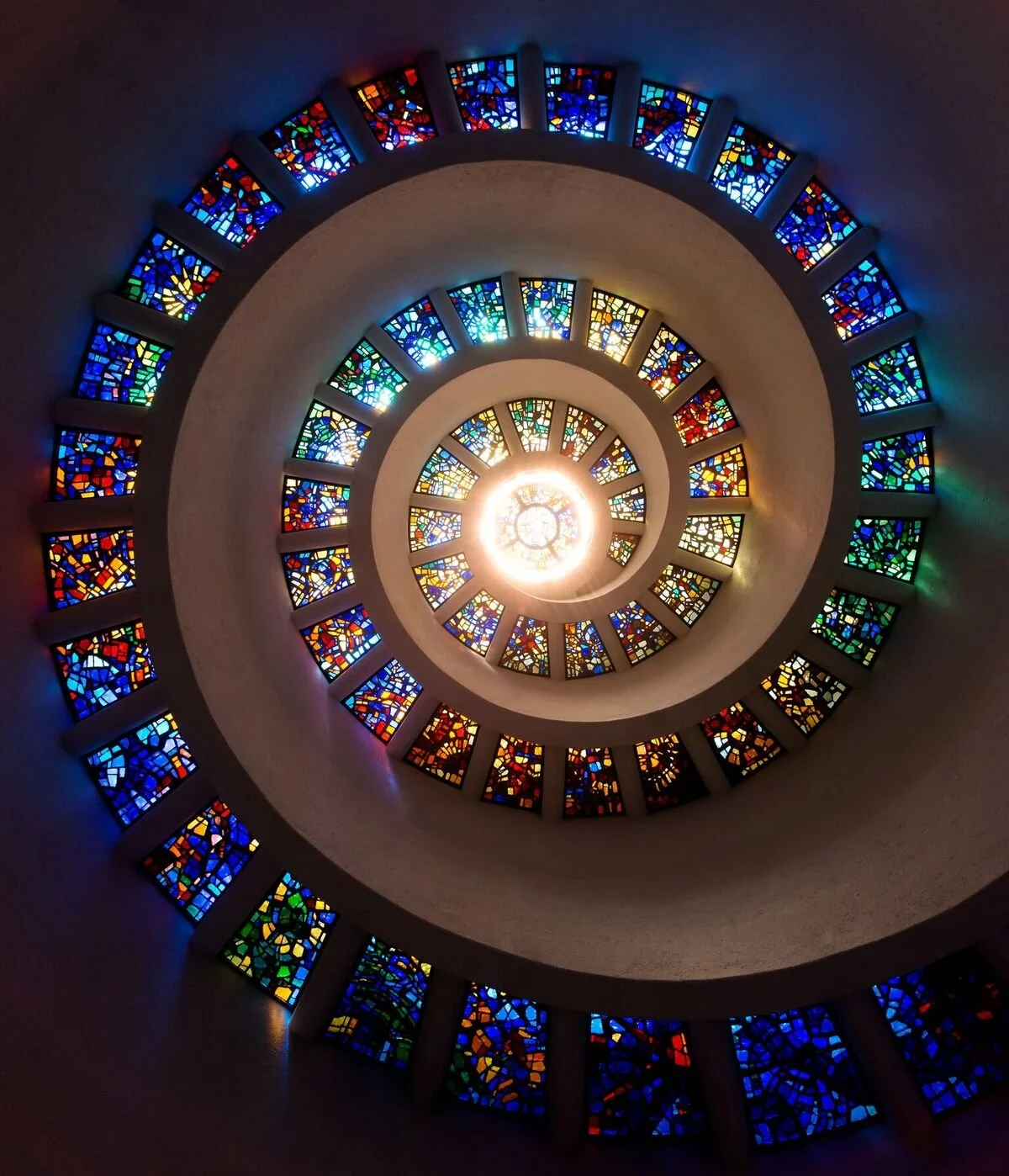
The Chapel of Thanks-Giving does not announce itself the way most landmarks do. It doesn’t compete with the glass towers around it. Instead, it spirals quietly upward from the street, almost improbably, like something discovered rather than constructed, an architectural idea that feels both ancient and distinctly of Dallas.
At the heart of Thanks-Giving Square, the chapel gives physical form to a concept that, until its creation, had never been given a place: gratitude. When Peter Stewart and a group of civic leaders began the project in 1964, Dallas was searching for a new story. The assassination of President John F. Kennedy the year before had cast a long shadow. The response was not another monument to power, but something quieter, a space for reflection, unity, and thanksgiving. Completed in 1976 during the nation’s Bicentennial, the chapel stands as both civic gesture and spiritual proposition.
Architect Philip Johnson, working with a team of artists and designers, translated that idea into form. The 90-foot spiral resists easy categorization. Some see a seashell, others a soft-serve cone, but its deeper lineage draws from the ancient “spiral of life” and even the ninth-century Great Mosque of Samarra. Across cultures, the spiral suggests ascent and continuity, an upward journey that mirrors the chapel’s intent.
That journey begins below street level. Thanks-Giving Square is designed as a descent from the city grid into a quieter, more contemplative environment. Visitors pass through the Court of All Nations before entering the chapel, moving from urban noise into a stillness that feels shaped by light itself.
At the center is the “Glory Window,” Gabriel Loire’s luminous stained-glass ceiling. Composed of 73 panels arranged in a spiral, it draws the eye upward in a deliberate motion, color intensifying toward a radiant center that feels less like an endpoint than an opening. The design invites stillness. It asks for a pause.
Around it, the Square unfolds as a carefully choreographed environment. Gardens, water, and layered pathways soften the edges of downtown, creating an urban oasis where the scale shifts and time slows. Within this space, the city recedes.
Not without critique, the chapel has been described as unconventional, even “kitschy,” yet it endures. Its distinctiveness provokes reaction, but its purpose grounds it. That tension may be part of its strength.
The artistic program extends beyond the chapel itself. John Hutton’s engraved glass panels bring voices from across traditions into quiet conversation, reinforcing the central idea: gratitude as both universal and deeply personal. The space does not prescribe meaning; it creates the conditions for it.
Visitors often experience it simply. Step inside. Look up. Let your eyes adjust. The chapel does not demand attention, it rewards it. Even its appearance in The Tree of Life feels natural, less a cameo than an extension of its identity.
Nearly fifty years after its completion, the Chapel of Thanks-Giving remains singular, neither purely civic nor purely spiritual, neither fully modern nor timeless, but something in between. In a city that continues to evolve, it offers a different kind of landmark—not one that marks progress, but one that invites reflection. A reminder that even in the center of a busy downtown, there is space for stillness, light, and the enduring act of giving thanks.