
A Center for the City’s Soul: The Building of Thanks-Giving Square
Editor’s Note
The following essay is drawn from a December 1972 interview with Peter Stewart, the visionary behind Thanks-Giving Square in Dallas, Texas. Presented here in the first person and using only his original words, it has been organized into a reflective narrative describing the origins, purpose, and creation of the Square.
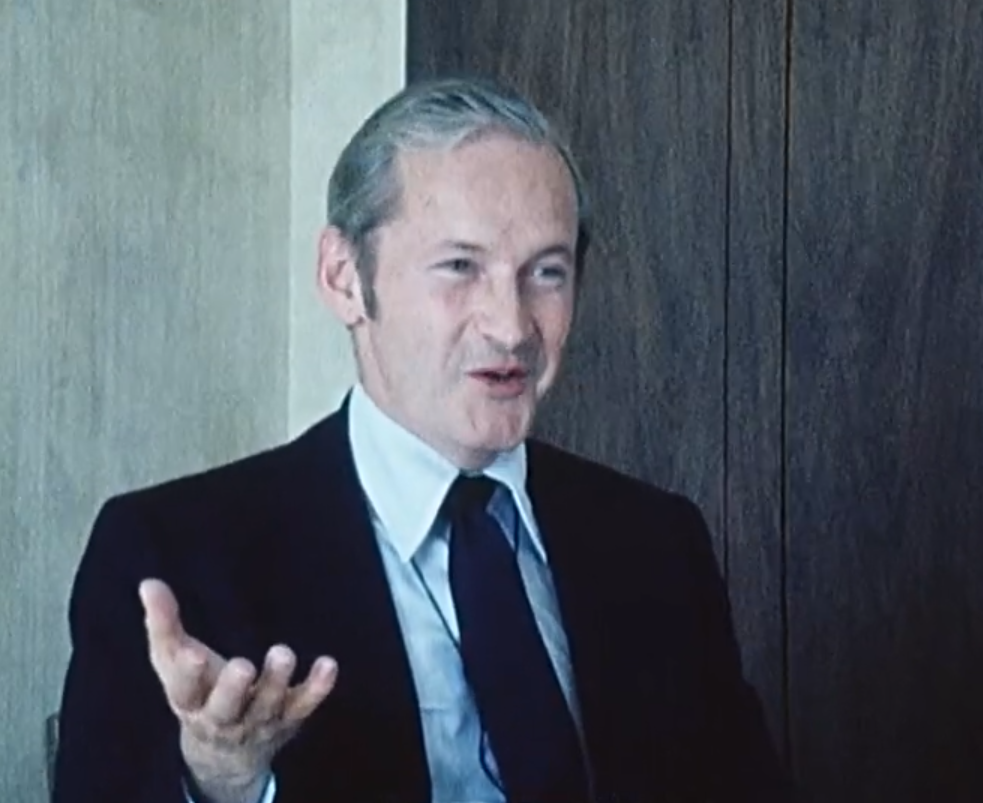
By Peter Stewart
In 1907, a group of clergymen got together and said, “We have one common religious holiday, and that's Thanksgiving, and we ought to celebrate it. We ought to celebrate it together.” So in 1907, Jew, Protestant, Catholic—just the whole spectrum of religious thought at that time—in a way that was completely unheard of, got together and had the happiest time, as reported in the papers, celebrating the good feeling between themselves. I think it's a great root, maybe, of our whole civic consciousness that is a background to everything we do in Dallas.
The idea of taking our highest ideal, if possible, and putting it in a beautiful open space grew on us. And so we feel that the idea itself kind of generated the motive power that has not stopped moving. The basic ideas, if I can digress, have come from a wide survey that we've taken, all the way from 1964—questionnaires we've given to all types of groups in all parts of town, asking what they wanted—so that we felt that we were in the mainstream of what people conceived this ought to be.
And of course, they came up with the green place they wanted—the trees and the water. And so naturally we honed in on what people wanted, and it proved that that was what people were also willing to pay for. A charitable foundation for this specific purpose was organized in 1964 and will be the vehicle, we think, that may be able to carry this on successfully, like Tivoli has been carried on successfully as a private enterprise, charitable religious foundation, maybe for several hundred years.
The city, in about 1968, was approved so that they could complete the then-surface pedestrian way, which cut across the western tip of Thanks-Giving Square—$475,000 for the purchase of property. That property on the west became a partnership in the obtaining of the property, which was the initial contact between the foundation and the city. That was about 18–19% of the purchase of the property.
Then the need for the underground terminal and underground facilities was another need that came up later, and for that, they are leasing from the foundation the area for the truck terminal and pedestrian way routes on a long-term lease—75 years, plus another 75 years.
About halfway between Akard to the west and Harwood to the east is the intersection of Pacific and Bryan, which was the old Pulley Bone Tower and now has been replaced by a 50-foot bell tower with three bells weighing approximately five tons that will humanize, we think, the city and be the integral part of this large welcoming court of flowers and a water wall that provides a vortex to entice people to come—not the straight ways down to the other stoplights and keep on the business direct route, but rather to take a little byway and come and get under the trees, get between the grassy banks, and get down into the sound of rushing water below the traffic, and suddenly take on a whole new environment.
From there, there are six different routes that one can take back into the city, or, if one feels slowed down and wants to enjoy the environment, going circling up across the bridge into the chapel—out of the garden now, with its pleasant noises masking the sounds of traffic—one comes into a place of silence: a small chapel, about 40 feet in diameter, with a stained glass ceiling that washes down on curved white marble aggregate walls.
And then, if one goes back into the city, one can go back in slowly—decompress, you might say—come out on this little platform, enjoy the view of people on various levels below and around, and the vegetation, and slowly wind out the way back into the city. And one actually comes back by the largest outpouring of water—2,500 gallons a minute—bubbling out at this point for a final look, and then back into the way of the city again.
The idea, which had been going around for so long—several thousand years at a minimum—that was part of everybody's life and life cycle, as has been said, never had a piece of property before. So this is the first little acre that the idea of Thanksgiving has ever had. The only similar thing, you might say, is liberty. Liberty has nine acres on Bedloe’s Island in New York Harbor, but Thanksgiving has one acre in the middle of Dallas, Texas.
So we felt that it was a very strong idea for the center of a town—something that needed to be a story, that needed to be told someplace in the world—and it just seems amazing to us that it's Dallas, Texas, that's able to tell it.
Context: The Making of Thanks-Giving Square
Peter Stewart’s reflections in this essay offer a personal account of the vision behind Thanks-Giving Square. Historical records and archival sources help situate that vision within the broader civic and architectural development of Dallas.
The project formally began in 1964, when Stewart and fellow civic leaders Joe O. Neuhoff, Julius Schepps, and John M. Stemmons established the foundation that would bring the Square to life. Emerging in the wake of President John F. Kennedy’s assassination, the effort reflected a desire to contribute to a renewed sense of purpose and identity for the city.
Development of the site unfolded over more than a decade. Land was assembled in 1968 through cooperation between the Foundation and the City of Dallas. Site clearance began on May 17, 1972, followed by construction in the early 1970s. The Chapel of Thanksgiving and bell tower were dedicated on Thanksgiving Day, November 25, 1976, during the U.S. Bicentennial, and the remainder of the Square opened to the public on May 8, 1977.
Architect Philip Johnson was commissioned to design the Chapel as part of an international search, reflecting the project’s global aspirations. Its spiral form and the stained-glass “Glory Window,” created by French artist Gabriel Loire, were conceived as elements of a unified symbolic environment—an immersive experience of light, space, and reflection.
Stewart played a central role in shaping both the vision and execution of the project, coordinating architects, artists, and civic partners while guiding fundraising and public engagement. The result was a space that brought together urban design, art, and spiritual expression in a single, distinctive civic setting.